
What is Coherence?
A reflection on inner alignment and the fields we carry


I would like to begin this reflective essay with the definition of coherence, because before we delve into anything deeply, it helps to understand the true identity of the word itself.
A dictionary definition describes coherence as the quality of different parts of something fitting together logically, clearly, or harmoniously.
It describes a state of unity where ideas, objects, or systems work together to form a clear and understandable whole.
Although this definition comes from a general source, I feel it captures something essential about how I have come to understand coherence. It is about harmony. It is about the way different parts of life begin to belong together.
I did not first meet coherence as a concept. I met it as a sensation — or perhaps more accurately, as a series of experiences.
I experienced it through small moments — the kind one almost misses because life has trained us to look for meaning only in large events.
A room would feel unsettled even though it looked perfectly fine. A conversation would sound ordinary, yet something in my body would quietly step back. A place would appear complete — benches, trees, paths, people passing through — and still something about it would feel slightly off, or dense, as if the atmosphere itself did not quite invite life to move through it.
At other times, I would enter a space and feel the opposite. The breath would soften. The mind would quieten. The body would no longer feel as though it had to guard itself from every direction.
Then I began to realise that much of what I had experienced in people, places, conversations, homes, institutions, food, and environments existed somewhere along this spectrum — between what gathers and what scatters, what settles and what disturbs, what feels aligned and what feels subtly out of relationship.
For a long time, I couldn’t articulate what I was feeling or experiencing. I simply noticed that some people, places, gestures, conversations, and rhythms helped me return to myself, while others pulled me away from myself. Some things gathered me. Others scattered me.
That was the beginning.
To make the most of this incredible instrument we possess, we have to develop our finer perceptions and learn how to read its signals accurately. The body has its own style of communication, and that communication is not always loud, literal, or immediately easy to understand. It may speak through sensation, contraction, ease, resistance, warmth, hesitation, tiredness, openness, or a quiet sense that something is not quite aligned.
Building a relationship with the body means learning its language over time. Each person has their own subtle vernacular, their own way the body speaks, warns, softens, resists, opens, and guides. Coherence begins when we become willing to listen to that language with maturity — not superstitiously, not dismissively, but with the respect due to a refined living intelligence.
In addition to the intelligence of the body, we have available to us a more direct faculty of knowing: intuition. I understand intuition as the perceiving faculty of the soul — the part of us capable of knowing truth directly, without depending entirely on sense experience, external evidence, or step-by-step reasoning.
This faculty exists in every human being, though in many of us it remains only partially developed. It begins to appear through the openings created by calmness: a quiet knowing, a subtle warning, a clear inner yes or no, a recognition that arrives before the mind has gathered its evidence. True intuition has a different quality from emotional impulse or mental fantasy. It is calm, precise, and inwardly steady.
Like any refined faculty, intuition has to be cultivated. It becomes clearer as the mind quietens, the emotions settle, the body becomes more finely listened to, and attention becomes less scattered. Through stillness, meditation, self-honesty, and discrimination, we gradually learn the difference between the soul’s quiet guidance and the many passing voices of fear, desire, habit, and imagination.
This is where coherence begins to deepen. The body becomes listened to as a living instrument. The mind becomes less crowded. Feeling becomes more refined. Intuition becomes easier to recognise. The human being begins to function with more of its intelligence available.
The Body Knows Before the Mind Explains
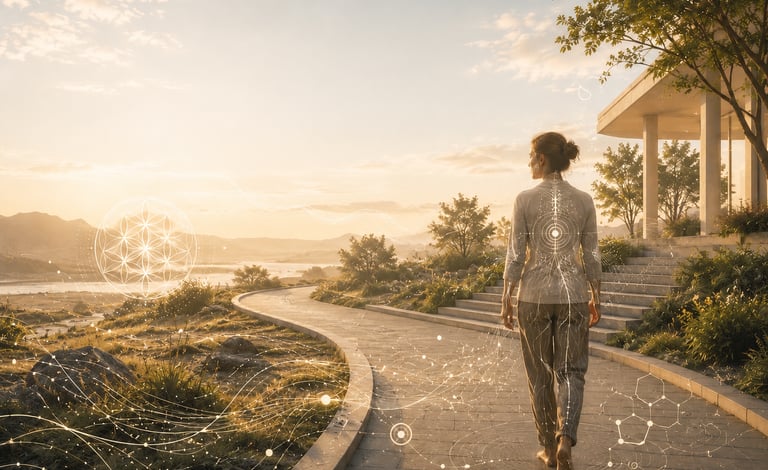
The more I observed myself, the more I began to realise that the body is constantly reading life. It reads tone, timing, pressure, sincerity, mood, rhythm, beauty, conflict, and safety. It reads rooms before we understand why a room feels uncomfortable. It reads people before we have formed an opinion. It reads the quality of a silence before anyone has spoken.
We often treat the body as something we carry around, something to feed, dress, exercise, rest, and occasionally discipline when it becomes inconvenient. But the body is not merely an object we inhabit. It is an instrument of perception. It's a very refined and precise living apparatus. The nervous system is not only managing survival; it is reading the field. It is gathering information all the time, receiving signals from the visible and invisible atmosphere around us.


Once I began to understand coherence as something the body can read, and something intuition can directly perceive, I began to sense another layer: life is always unfolding within fields.
By field, I mean the atmosphere of a person, place, object, relationship, or environment — not only what is physically present, but the subtle quality carried within it. Every person enters a room with a field. Every home contributes something to a street. Every street contributes something to a suburb. Every thought, feeling, intention, memory, wound, prayer, habit, and unresolved pattern becomes part of the atmosphere we carry.
We may smile. We may speak kindly. We may try to appear generous, calm, or pleasant. But beneath the surface, something deeper is still communicating.
The Field We Carry
Coherence invites us to sense beyond the visible surface. Behaviour, appearance, words, and outer form all reveal something, but they are not the whole story. Beneath them is a quality of presence — the deeper field being carried — and it is this field that quietly shapes how a person, place, object, or relationship is experienced.
Something may appear pleasant, polished, or orderly, yet carry a very different atmosphere beneath the surface. It is this subtler quality that we often feel first: the tone beneath the words, the density behind the beauty, the ease or unease moving through the space before the mind has fully understood why.
This naturally raises the question of aura. In everyday language, aura refers to a distinctive atmosphere or quality that seems to surround and emanate from a person, place, or thing. In that sense, aura is close to what I mean by field. But coherence is not merely the presence of a field. It is the degree of harmony, balance, and right relationship within that field.
A person may have a strong presence and still feel disorganising to be around. Someone may be magnetic, intense, impressive, even powerful, and yet leave others feeling scattered after being near them. Another person may be quiet, understated, almost invisible by worldly standards, and yet their presence settles the room.
So the question is not only whether a field is strong, noticeable, or impressive. The deeper question is whether it is clear, balanced, and life-supporting.
This is where individual coherence stops being a private matter. If the field we carry enters every space with us, then our inner state is never entirely ours alone. The atmosphere within us becomes part of the atmosphere around us. The field we carry is shaped by the state of our nervous system, the openness of our heart, the quality of our thoughts, the honesty of our intentions, and the degree of steadiness we have cultivated within ourselves.
This understanding is not meant to create self-consciousness or pressure. It is meant to awaken care. The more we realise that we are always contributing to the spaces we enter, the more naturally we begin to tend the atmosphere within us.
Meditation, breath, self-awareness, emotional honesty, prayer, healing, forgiveness, integrity, and the quiet discipline of returning to centre are not only personal practices. They refine the field we carry. They change the quality of what we bring into a room, a family, a friendship, a workplace, a street.
A person who has cultivated inner steadiness may not need to say very much to shift a space. Their presence alone can settle something. Not through force or performance, but because their presence carries fewer inner contradictions. The nervous systems around them receive a different signal. The field has permission to soften.
We have all experienced this in some form: the person whose presence makes a room feel safer, the elder whose silence carries more authority than another person’s speech, the teacher whose steadiness allows students to relax, the friend around whom we do not have to perform.
In this sense, becoming coherent is not only for our own peace. It becomes a form of care — a way of taking responsibility for the atmosphere we help create. Because wherever we go, we are always contributing.
In this sense, becoming coherent is not only for our own peace. It becomes a form of care — a way of taking responsibility for the atmosphere we help create. Wherever we go, we are always contributing. And because life is relational, what we contribute does not simply disappear. It moves through the field, touches others, shapes the spaces around us, and in time returns to us in some form. The quality we bring into life becomes part of the quality of life we meet.
If the field we carry affects the spaces we enter, then the next question becomes very practical: how do we become steady enough to carry a clearer field?
For me, this return has always been connected to the spine.
It may sound simple, but over time I have come to understand the spine as the body’s most direct reference point for the inner axis — the place where physical structure, nervous-system intelligence, and subtler orientation meet.
The spine houses the central nervous system and connects directly with the brain, but it also seems to carry a deeper symbolic and spiritual significance. It is where awareness can begin to gather, where scattered attention can return, and where the human being can begin to feel inwardly upright again.
I began to understand this not as an abstract idea, but through noticing where my awareness went when I felt scattered. It was not simply that my thoughts became busy or my emotions became unsettled. Something in my whole orientation moved forward and outward, as though my attention had left the deeper axis of the body and gone out to meet the world too quickly.
I began living too much from the front of the body: from the face, the chest, the social self, the part of me that responds, explains, reaches, manages, protects, or tries to meet life before it has returned to itself. The front body is where we encounter the world, and it is beautiful in its own way. It allows expression, warmth, speech, giving, receiving, and human contact.
The Spine As The Inner Axis
But when awareness lives too far forward for too long, the system becomes overexposed. Every tone reaches us too quickly. Every reaction enters too deeply. Every outer movement begins to shape the inner state. Slowly, without realising it, we may begin leaning into life in a way that pulls us away from the spine as our inner reference point.
This is why the movement back became important for me. The back body felt different. It was quieter, more vertical, less performative. It felt like the part of the body that remembered support from within. When I could sense the back of the body again, I was not withdrawing from life; I was returning to a deeper place from which life could be met more steadily. During meditation, when my mind would wander or emotional intensity would rise, I often found myself inwardly stepping back — not physically, but in consciousness — into the back of the body. There, I would sense a vertical line of steadiness, as though the back body gave me access to the spine again.
At first, I did not fully understand why this movement backward felt so necessary. I had assumed that inner attention would naturally gather somewhere in the centre, especially when focusing inwardly. But what I began to notice was more precise than that. My awareness was not merely moving inward; it was moving back, as though it needed to find the spinal axis from the rear side of the body. It was as if the system itself knew that steadiness did not come from floating vaguely in the centre, but from returning to the spine as a living support.
Over time, this began to make sense. To “step back” is not always to withdraw. Sometimes it is to return to the axis.
When we say to someone, “Step back and take a breath,” there is more wisdom in that phrase than we realise. We are not only asking them to pause mentally. We are inviting them to move out of reaction and back into the deeper structure of themselves — back into awareness of the spine as the inner axis, back into the breath, back into the place from which constructive response becomes possible.
This is the axis I keep returning to: the vertical line of being that allows us to participate in the horizontal movement of life without being swallowed by it. The horizontal world is full of relationships, work, family, society, responsibility, speech, movement, and change. It is where life happens. But without the vertical axis, we are easily governed by whatever comes toward us. With the axis, we can meet life without leaving ourselves.
This, to me, is where coherence begins to become embodied.


If the spine gives the body its inner axis, the breath is one of the gentlest ways we return to it.
Breath is easy to overlook because it is always with us. It does not ask for belief. It does not require explanation before it begins working. It is both ordinary and profound — the quiet bridge between body and soul, between the nervous system and the subtler life moving through us.
When I am scattered, the breath is usually one of the first things to change. It becomes shallow, uneven, held, or slightly hurried. Sometimes I do not notice it at first. I only notice that my thoughts have become louder, my body has moved forward, my attention has left the spine, or the world has begun entering me too quickly. Then, when I return to the breath, I realise it had been quietly revealing the state of my system all along.
The breath has a strange honesty; It does not accuse. It reveals.
The breath shows us where we are. It shows us whether we are bracing, rushing, resisting, softening, opening, or settling. It gives us a doorway back into the body without force. A single conscious breath can interrupt the momentum of reaction. A few steady breaths can begin to change the inner atmosphere. Over time, repeated return to the breath teaches the nervous system that it does not have to be governed by every outer movement.
Posture matters here too. When the body collapses, contracts, or leans too far forward into life, the breath often becomes restricted. When the body becomes more upright, when the spine is remembered, when the shoulders soften and the chest is no longer armoured, the breath has more room to move. In this way, breath and spine begin to work together. The axis gives the breath a pathway. The breath gives the axis life.
This is not about controlling the breath harshly or using it as another form of self-discipline. It is about relationship. The breath can be trained, but it is trained most deeply through gentleness, consistency, and attention. When we breathe with awareness, we are not simply moving air in and out of the lungs. We are giving the whole system a rhythm to organise around.
The breath says, return.
Return to the body. Return to the spine. Return to the present moment. Return to the place within you that can respond rather than react.
In this way, breath becomes a quiet trainer of coherence. It helps awareness gather again. It softens the front body when it has become too defended. It brings attention back toward the axis when the world has pulled it outward. It gives the nervous system a lived experience of steadiness — not as an idea, but as something felt.
This is why meditation and conscious breathing are not separate from the way we move through the world. They prepare the field we carry. They train us to enter rooms with more steadiness, to listen without collapsing into another person’s mood, to speak without scattering ourselves, to feel without being flooded, and to meet life without abandoning the centre.
The more we return to the breath, the more the body begins to remember the way back. What first requires effort slowly becomes familiar. What is familiar becomes available. What is available, over time, becomes natural.
And this is one of the quiet miracles of coherence: the nervous system can learn. The breath can teach. The axis can be returned to again and again until returning becomes less of a practice and more of a way of being.
Breath: The Quiet Trainer Of The Nervous System
There is another small practice that has helped me understand coherence in a very embodied way: the gesture of pranam.
Pranam or Vanakkam in Tamil is a traditional gesture of reverence, often made by bringing the palms together at the heart or gently bowing the head. In many Indian traditions, it is a way of honouring the divine, the sacred, the teacher, the elder, or the soul within another being. It can be simple and cultural, but it can also be deeply interior. At its essence, pranam is not only a greeting. It is a gesture of alignment.
When the palms come together, something in the body gathers. The hands no longer move outward in separate directions. The chest softens. The head lowers slightly. The breath becomes more aware of itself. The body remembers humility without collapse, respect without smallness, and presence without performance.
The Gesture That Maintains The Axis


For me, this gesture has become more than a formality. It has become a way of returning to the axis.
When I bring the palms together, I notice that my attention gathers toward the centre and then naturally remembers the spine. The gesture seems to draw the scattered parts of me back into one line. The hands, heart, breath, head, and spine begin to speak to one another again. Even before words are spoken, the body has already made a choice: to meet the moment from steadiness, reverence, and inner order.
This is why gestures matter. The body is not separate from consciousness. A gesture can train a state. A posture can invite a quality. A small movement, repeated with sincerity, can teach the nervous system how to return.
Pranam, in this sense, is not about appearing spiritual. It is a quiet technology of coherence. It reminds the body where to gather. It reminds the mind to soften its sharp edges. It reminds the heart that reverence is a form of intelligence. It reminds the whole being that meeting life does not always require reaching outward first. Sometimes it begins by becoming inwardly aligned.
There is a dignity in this. Not the dignity of pride, but the dignity of right placement. The gesture places the human being in relationship — with the other person, with the moment, with the divine, with the field, and with the inner axis.
And when the axis is remembered, even a simple gesture becomes a doorway. It keeps the body from rushing too far ahead of the soul. It allows the breath to remain close. It helps the nervous system receive the world without immediately scattering into it.
This is how coherence is trained in small ways. Through breath. Through posture. Through gesture. Through the quiet repetition of returning until the body begins to understand what the mind alone cannot hold.


Once we begin to understand that every person carries a field, relationships start to look different.
A relationship is not made only of what two people say to one another. It is shaped by the quality of presence each person brings into the space between them. Words matter, of course. They can clarify, wound, bless, confuse, repair, or conceal.
But around the words, there is always more being communicated: tone, timing, intention, memory, emotional residue, nervous-system response, sincerity, and the degree of openness or defence moving through the exchange.
Relational Coherence
This is why two people can say all the right things and still leave one another feeling unsettled. It is also why a very simple conversation can feel deeply nourishing when the field between people is honest. Relational coherence is not created by perfect speech. It begins when what is spoken, what is felt, what is intended, and what is carried beneath the surface begin to move closer into alignment.
We know this in the body. We can feel when someone is listening with their whole being, and we can feel when they are only waiting for their turn to speak. We can feel when kindness is genuine and when it is being used to hide resentment. We can feel when silence is peaceful, and when silence is full of punishment, withdrawal, or fear. The body reads the relational field long before the mind has arranged its explanation.
To become coherent in relationship is to become more truthful in the space between ourselves and others. It is to notice the quality we are bringing into an exchange before we try to manage the exchange itself. It asks us to become attentive to the state of our body, breath, intention, and heart while we speak, listen, disagree, apologise, receive, or set a boundary.
This kind of coherence does not require us to become endlessly agreeable. In fact, agreement is not always coherence. Sometimes coherence requires a clear no, a difficult truth, a pause, an apology, or a loving distance. What matters is the quality from which the action arises. A boundary can be coherent when it comes from clarity rather than punishment. A disagreement can be coherent when it is held with respect. A silence can be coherent when it protects reflection rather than avoidance.
The more coherent we become within ourselves, the more relational space begins to change. We stop needing to dominate the field, rescue the field, perform in the field, or disappear from it. We become more able to remain present without losing ourselves. We can listen without absorbing everything. We can speak without forcing. We can care without collapsing. We can hold another person’s humanity without surrendering our own centre.
This is one of the quiet gifts of relational coherence: it allows truth and kindness to occupy the same space. It allows people to meet without immediately becoming entangled in old patterns. It gives the relationship a chance to breathe.
And sometimes, that is enough for something new to become possible.


This same principle appears in groups.
I remember being in a class once, surrounded by people of different ages and abilities, and noticing an old instinct that might once have arisen in me. In a new room, the ego often wants to locate itself. Am I ahead? Am I behind? Do I need to prove something? Do I need to hide? Do I need to appear capable? Do I need to soften myself so others are comfortable?
These questions may never be spoken aloud, yet they quietly shape the field of a room. A group can appear calm on the surface while, underneath, many people are trying to find their place through comparison. Some reach forward. Some pull back. Some perform confidence. Some disappear into politeness. Some take up more space than they need. Others give away space before anyone has asked them to.
But that day something quieter was present. I did not feel the same need to overshine or underperform. I could simply be there. Moving with the group. Learning with the group. Not making the room about me, and not erasing myself from it either.
That moment clarified something. Coherence in a group is not created by everyone being equal in skill, age, knowledge, confidence, or temperament. It is created when each person begins to become rightly placed. When one person’s strength does not need to diminish another person’s presence. When one person’s uncertainty does not need to become shame. When difference can exist without the room turning into a hierarchy of worth.
We have all felt the difference between a room where people are trying to position themselves and a room where people are able to be present. The first may still function. It may even look impressive. But much of the energy is spent on image, comparison, and quiet self-protection. In the second, attention becomes more available. The body softens. People can listen more easily. Learning, truth, humour, creativity, and genuine exchange have more space to move.
This is coherence at the level of group life.
Not perfection. Not constant agreement. Not everyone becoming the same. A coherent group can still contain different personalities, different capacities, different roles, and different levels of confidence. What changes is the quality of the field. The room no longer requires people to fight for position or disappear in order to belong.
When a group becomes more coherent, the atmosphere itself begins to teach. People sense what is permitted there: sincerity, effort, humility, contribution, rest, learning, and truth. The group becomes more than a collection of individuals. It becomes a shared field where each person’s presence affects the whole, and the whole, in turn, helps each person become more rightly placed within themselves.
This is why rooms matter. A classroom, meeting, workshop, family gathering, prayer circle, or community space is never just a gathering of bodies. It is a living field of nervous systems, intentions, memories, hopes, insecurities, strengths, and unspoken agreements. The more conscious we become of this, the more carefully we can enter groups — not asking only, “How am I being seen?” but also, “What quality am I contributing?”
A coherent room does not need everyone to be extraordinary. It only needs enough people willing to become honest, steady, and rightly placed. From there, the field begins to change. People breathe differently. They listen differently. They learn differently. And quietly, the room becomes a place where life can organise itself with more dignity.
Coherence in Groups and Rooms


Once I began to understand field in people and groups, I started sensing it in homes and streets too.
A house carries a field. Not only because of its architecture, furniture, colour, or arrangement, but because of the life being lived inside it. The conversations repeated there. The meals prepared there. The conflicts held there. The affection expressed there. The grief stored there. The care, neglect, prayer, hurry, silence, laughter, pressure, or tenderness that gradually settles into its atmosphere.
Over time, a home begins to carry an imprint of the lives it has held.
Some homes feel warm before anyone has offered hospitality. Some feel tense even when everything is clean and beautiful. Some feel tired. Some feel sealed. Some feel open. Some feel as though the walls themselves have learned how to breathe. The body often recognises this before the mind has any reason for it.
Home, Streets, And Suburbs
A street becomes a gathering of these fields. Each house contributes something. Each garden, doorway, fence, tree, car, window, and front path participates in the atmosphere. Over time, a street develops its own subtle personality. A suburb does too.
This is why a suburb can be wealthy, popular, and highly sought after, yet not feel coherent. I have been in affluent places where everything looked impressive from the outside — the houses, the landscaping, the cars, the polish — and yet my whole system wanted to leave. The field felt dense, sealed, and strangely airless, as though the outer success of the place had not translated into inner harmony.
And then there are other places, perhaps less polished, less admired, less socially elevated, where the body can breathe. A modest street may carry warmth. A simple home may feel deeply settled. A less fashionable suburb may hold more ease than a place whose surface has been carefully perfected.
This matters because modern life often mistakes affluence for coherence. We assume that if a place is expensive, desirable, well-maintained, or aesthetically pleasing, it must also be harmonious. But coherence is not the same as wealth. It is not the same as beauty. It is not the same as status.
Material refinement alone cannot create coherence. A place may be simple, modest, even sparse, and still feel deeply coherent if the visible and invisible dimensions are in balance. But the reverse does not always hold. A place may have wealth, beauty, design, status, and comfort, yet still feel unsettled if the deeper field is strained.
Coherence is not created by material abundance. It arises when the outer form and the inner quality of a place are in right relationship.
This is why the body remains such an important instrument. It helps us discern the difference between polish and peace, between beauty that decorates and beauty that nourishes, between a place that impresses the eye and a place that allows life to settle.
The same principle applies to what we consume.
Food is not only physical substance. It carries a field too.
This matters because food is one of the most intimate ways the external world becomes part of us. We do not merely look at food, pass through it, or stand near it as we might stand in a room or walk through a street. We take it in. It enters the body, the bloodstream, the nervous system, the gut, the tissues, and the energetic system. Its quality and quantity affect us deeply.
We often speak of food in terms of nutrients, calories, ingredients, chemicals, allergies, intolerances, diets, and health trends. All of that has its place. The physical composition of food matters. But there is another layer that is rarely discussed with enough seriousness: the coherence of the food’s journey.
How was it grown? How was it handled? What kind of land did it come from? Was it produced through care, respect, and rhythm — or through suffering, speed, exploitation, violence, greed, and artificial manipulation? What was the intention behind it? What was the field of the place where it was prepared? What was the state of the person who cooked it?
These questions may sound subtle, but the body is subtle. Many sensitive people have been made to feel that something is wrong with them because their bodies respond strongly to food, environments, chemicals, noise, or emotional atmospheres that others seem able to tolerate. Of course, physical symptoms should be taken seriously, and medical advice has its place. But seeking help does not mean abandoning our own discernment. The body is always communicating. Part of becoming coherent is learning to listen to that communication with responsibility rather than shame
Food As Field


Sometimes the body rejects what the world calls normal not because it is failing, but because it is becoming more honest. As human beings become more refined, more aligned with themselves, and more sensitive to truth, certain foods or food systems may no longer feel compatible. This sensitivity is not weakness. It may be a sign that the system is becoming more finely attuned to what nourishes it and what disturbs it.
There are, of course, physical reasons for food allergies, intolerances, and illness, and they should not be dismissed. But alongside the physical, there may also be an energetic dimension to why certain foods no longer feel compatible with increasingly sensitive systems. Food that is overly artificial, heavily processed, carelessly prepared, or produced through incoherent systems may carry an imprint that the body recognises, even if the mind does not.
When we ingest food, we do not only take in its chemical structure. We take in something of its field, and that field becomes part of our own.
This is why food prepared with love can feel different. It is why a simple meal made with care may nourish more deeply than something elaborate made in haste or resentment. Intention is not a decorative extra. Intention has energy.
The fast-food model reveals this clearly. It is not only the ingredients that matter, though they do. It is also the speed, pressure, repetition, artificiality, emotional atmosphere, and collective coherence of the space in which the food is made. When food is produced within a field of exhaustion, indifference, exploitation, or mechanical urgency, something of that enters the meal.
And then it enters us.
If we are becoming more coherent, it makes sense that we may begin craving more coherent food — food grown, prepared, and received with greater care, simplicity, gratitude, and alignment.
Perhaps this is not about becoming precious or fearful around food. It is about becoming relational with food again.
To ask not only, “What is this made of?”
But also:
“What field does this carry?”
From homes, streets, and suburbs, the same understanding begins to widen into physical space itself.
A room is not only walls and furniture. A park is not only grass and benches. A library is not only shelves and services. A school is not only classrooms and curriculum. Every space carries a field, and every space is quietly shaping the nervous systems, behaviours, movements, and possibilities of those who enter it.
Some spaces gather us. Others scatter us. Some invite the body to soften. Others make it brace. Some allow attention to settle, while others keep the senses slightly on edge. We may not always know why, but the body often knows whether a place supports life, interrupts it, or asks too much of it.
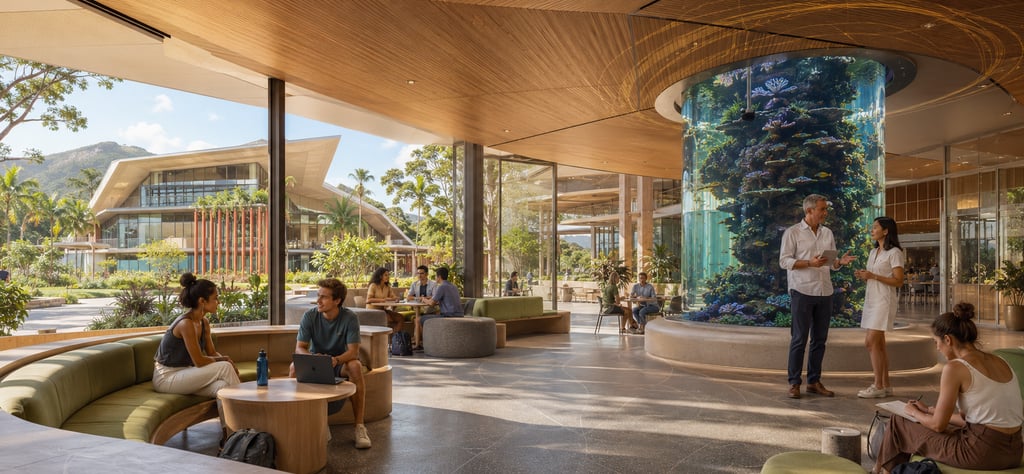
This is why spatial coherence matters. A coherent space is not simply a space that looks attractive or functions efficiently. It is a space whose outer form, inner quality, human use, ecological intelligence, and living context are in right relationship. It considers not only what a place is meant to do, but how it feels to move through it, rest within it, learn inside it, gather around it, and return to it again.
Light matters. Sound matters. Proportion matters. Thresholds matter. Flow matters. Texture, shade, air, privacy, openness, rhythm, and orientation all matter. But so do the living beings placed within and around a space: the trees, plants, birds, insects, animals, soil organisms, and seasonal rhythms that quietly shape the field. Spatial coherence cannot be only human-centred. A place becomes more coherent when it supports the wider web of life, not just the convenience of one species.
Local councils in many parts of the Western world have already become more aware of the need to support native plants, restore biodiversity, protect habitat, and design public spaces with ecological value. This is important work. But there is still much more that can be sensed, studied, and refined. The question is not only, “Is there greenery here?” It is: what kind of greenery, for whom, in what relationship, and with what effect on the whole field?
The choice of plants and trees matters deeply. Some provide shade. Some attract birds. Some support pollinators. Some repel insects. Some hold moisture in the landscape. Some offer shelter during storms. Some nourish soil. Some carry medicinal, cultural, or spiritual significance. A coherent landscape is not assembled merely for appearance; it is planted with relationship in mind.
I remember a conversation with our dear family friend Ray, who worked closely with natural insect protection and had a neem farm. He spoke with real conviction about neem and its natural insect-repelling qualities. His work even extended into large-scale public settings, and he had explored the possibility of encouraging councils to plant neem trees in parks and public areas as a more natural way of reducing insect bites. That conversation stayed with me because it opened a deeper design question: what if the plants we choose could reduce the need for harsher interventions? What if shade, scent, leaf, root, and ecology were understood as part of public health and spatial coherence?
Of course, plant choices must always be made with ecological suitability, local climate, native biodiversity, and land context in mind. Not every beneficial plant belongs everywhere. But the principle remains important: coherent design asks us to think beyond surface beautification and toward living function. A tree is not just decoration. A plant is not just landscaping. A garden is not just visual softness. These are living participants in the field.
I have seen this in small, practical ways too. In a Brisbane suburb, I noticed two enclosed dog parks side by side within a larger park area where people gathered and played sport. At first, I wondered why there were two. Then I realised one was for smaller dogs and the other for larger dogs. It seemed so simple, and yet so thoughtful. Our family dog, Kaya, is quite large, and she does not always appreciate smaller dogs moving around her legs. She may bark to assert a boundary, which can be frightening for a little dog. That design choice recognised difference without creating conflict. It allowed different bodies, needs, temperaments, and scales to coexist more peacefully.
This too is spatial coherence. Not grand. Not mystical. Just intelligent relationship made visible.
The same principle applies to birds needing places to rest, nest, or shelter from storms. It applies to insects needing habitat rather than being treated only as nuisance. It applies to children needing softness, elders needing shade and seating, dogs needing appropriate space, and people needing places to gather without feeling crowded or exposed. A coherent public space thinks across species, across ages, across scales of vulnerability, and across rhythms of use.
This is why I think we often underestimate public spaces. A park, for example, is not merely a pleasant patch of green placed inside a suburb. At its best, it becomes a shared place of regulation and renewal. It gives the public body somewhere to exhale. It offers shade, movement, rest, beauty, visibility, refuge, and gentle social permission. It allows children to play, elders to sit, walkers to pass, birds to gather, dogs to move safely, insects to participate in the ecology, and strangers to be near one another without feeling invaded.
A coherent park does not force community, but it makes community more possible. It does not demand interaction, but it softens the conditions around it. It allows life to gather without being over-managed.
This is also why some places, despite being technically complete, do not feel alive. A picnic area may have tables, paths, grass, bins, lighting, and facilities, yet somehow people do not gather there. The furniture of welcome exists, but not the field of welcome. Something in the arrangement, the atmosphere, the planting, the shade, the sound, the exposure, or the relationship with the land has not quite opened.
The body can feel the difference. Animals can feel it too. Birds, insects, children, elders, and sensitive nervous systems all reveal, in different ways, whether a place has truly been designed for life.
Spatial coherence asks us to look beyond function alone and begin sensing how space participates in life. Does the place help beings breathe more easily? Does it support attention? Does it invite care? Does it create dignity? Does it offer refuge as well as movement? Does it honour the land beneath it? Does it allow plants, animals, people, and seasonal rhythms to come into better relationship?
A coherent space does not need to be grand. It does not need to announce itself. Sometimes it is a humble corner with good light, a pathway that feels naturally placed, a tree that gathers people without effort, a planting choice that quietly reduces discomfort, a dog park designed with different animals in mind, a courtyard that holds conversation gently, or a library nook where the nervous system finally stops scanning.
In this way, spatial coherence is not only design. It is listening made visible. It is the art of arranging space so that life — human, animal, plant, and unseen — has a better chance of becoming whole within it.
Spatial Coherence


The Child and the Hand Dryer


The lights. The noise. The height of fixtures. The echo in rooms. The sharpness of transitions. The lack of softness. The overstimulation. The adult assumption that if a space looks new, clean, and functional, it must be good.
But a child’s highly sensitive and attuned nervous system tells another story.
This is why spatial coherence matters so much in education, libraries, public buildings, and family spaces. Children are open systems. They absorb what adults have learned to tolerate. A loud hand dryer, a harsh classroom, a chaotic corridor, a visually busy wall, a space without refuge — all of these can become part of the child’s inner weather.
A coherent space for children is not merely safe by regulation. It is safe to the nervous system.
It allows the child to remain available to learning, wonder, relationship, and self-trust.
That small moment in the library reminded me that design is never neutral. Every sound, surface, threshold, fixture, and rhythm is either helping the human system regulate or asking it to endure.
I once noticed this in a newly built library in the suburbs.
The building was new and visually pleasant. It had the clean, polished feeling of a contemporary public space — functional, attractive, seemingly well-designed. But in the ladies’ bathroom, I witnessed a small moment that stayed with me.
A mother had brought her young son in with her. I was using the hand dryer near the basin, and the sound filled the space with that sudden mechanical roar hand dryers often produce. Immediately, the child said to his mother, “That’s so loud, Mum.”
It was such a simple sentence. But it was a profound insight.
At his height, the dryer was positioned above him, almost like a machine roaring over his head. What to an adult might be a brief inconvenience could feel, to a child’s nervous system, like the whole world had suddenly become sound. His body was receiving the design directly. Not as an idea. Not as a complaint about acoustics. As an experience.
In that moment, I thought about how constantly children are being shaped by spaces adults have designed without truly entering the child’s body.
Universities and the Field of Learning
I have felt this in learning environments too.
Some of the most affluent or prestigious universities I attended had impressive reputations, beautiful buildings, historic weight, and institutional confidence. On paper, they carried status. In reality, I often struggled to learn there. Something about the field felt off. The spaces did not help me settle into myself. They did not make learning feel alive in my body. There was knowledge there, certainly. But knowledge alone does not create coherence.
Then, unexpectedly, I found something different at James Cook University in Townsville.
At the time, it was not the most famous or glamorous university in my life. It was simpler. More open. Built across vast land, away from the intensity of a busy city. There was space around it. Air. Distance. A slower rhythm. Even senior management seemed to share space with students in a way that felt less hierarchical, less sealed off, more human.
And there, I found my niche.
This taught me something I could not have understood through rankings or reputation.
A learning environment is not coherent because it is prestigious. It is coherent when the field supports learning. When the body can settle. When the mind can open. When hierarchy does not choke curiosity. When land, architecture, rhythm, access, and human culture create a space where knowledge can actually be received.
A university may be globally admired and still feel inwardly fragmented.
Another may be humbler and yet more conducive to the soul of learning.
That is coherence.
Not the branding of intelligence, but the conditions through which intelligence can breathe.
Ancient Spatial Wisdom


These systems understood that human beings do not live only in structures. We live in fields. Our homes, temples, streets, schools, and cities are not containers for life; they are participants in life.
Modernity has often treated space as a technical problem. How many rooms? How much square footage? What materials? What cost? What efficiency? What compliance?
All of that matters. But coherence asks another layer of questions.
Does the space breathe?
Does it gather or scatter attention?
Does it support the body?
Does it honour the land?
Does it invite right relationship?
Does it help the people inside become more whole?
This is where old spatial sciences and future design may need to meet again.
Not through superstition.
Not through rigid formula.
But through refined listening.
What I have been describing is not new.
Many traditional cultures understood that space has intelligence, that placement matters, that direction, flow, threshold, proportion, elements, light, sound, and relationship all affect the human field.
Feng Shui and Vāstu Śāstra, for example, are often simplified in modern culture into rules about where to place furniture, doors, beds, mirrors, or objects. But beneath the rules is a deeper recognition: life moves through space, and space shapes life.
There is a way to arrange a dwelling so that energy flows more harmoniously.
There is a way to orient a building so that it does not fight the field around it.
There is a way to read a site before building upon it.
There is a way to notice where movement gathers, where it stagnates, where it leaks, where it overwhelms, where it settles.
Land as Living Relationship


Beneath all spatial design is land.
Before any building is placed, before any path is drawn, before any program is imagined, there is already a living field: soil, water, wind, trees, animals, climate, memory, community pattern, and the subtle relationships moving through a place.
Modern design often begins with the question: what can we put here?
Older land-based traditions begin with another question: what is already here?
This is where Aboriginal custodial wisdom becomes essential to any serious conversation about coherence on this land. Aboriginal peoples have lived the language of land coherence for tens of thousands of years — not as an abstract theory, but as a continuous practice of listening, tending, reading, remembering, and belonging with Country. When it comes to land, ecology, seasonal intelligence, and the subtleties of place, this is not peripheral knowledge. It is mastery carried through generations.
This must be approached with humility, not extraction. Aboriginal knowledge is not a decorative layer to place on top of modern projects. It belongs to living peoples, places, Elders, responsibilities, and laws of relationship. Just as we turn to specialists for particular kinds of knowledge, any serious attempt to understand the coherence of land in Australia must recognise Aboriginal custodians as profound specialists in Country.
One of the great reminders within this wisdom is urgently needed in modern life:
Land is not backdrop.
Land is participant.
Country is alive with relationship, story, law, memory, responsibility, and reciprocity. This changes the whole question of design. A coherent place cannot be created by imposing an idea upon land that has not been listened to. It must emerge through relationship — with land, water, trees, animals, history, community, and with what should be touched and what should be left alone.
The external appearance of a place can reveal the invisible relationships operating within it. A space that is unused, neglected, tense, exposed, or strangely unwelcoming may be showing more than a design flaw. It may be showing a relational imbalance. Not in a spooky way. In a living way.
Places, like people, respond to care, neglect, rhythm, violence, attention, and love.
To speak of coherence, then, is not only to speak about the individual. It is to speak about participation. How do we enter a place? How do we listen before acting? How do we restore right relationship rather than simply impose function?
Where modernity often asks how land can serve human ambition, custodial wisdom asks how human presence can serve the balance of place.
That, too, is coherence.
The Ache Beneath Everything
Once we begin to understand coherence as right relationship, the ache beneath everything becomes easier to recognise.
It is not only the ache of an individual who feels scattered. It is the ache of life out of relationship.
A body out of relationship with its breath.
A mind out of relationship with truth.
A nervous system out of relationship with safety.
A person out of relationship with their own soul.
A home out of relationship with peace.
A city out of relationship with nature.
A food system out of relationship with care.
A society out of relationship with the land beneath it.
The same pattern repeats at different scales. What happens within the human being eventually appears in the structures we build, the food we produce, the spaces we design, the conversations we have, the systems we tolerate, and the futures we imagine. Inner incoherence becomes outer incoherence when it is repeated by enough people, normalised through enough habits, and built into enough institutions.
And perhaps this is why every human being longs for coherence, even without using that word. We may think we are longing only for success, love, stability, recognition, beauty, belonging, or peace. But beneath many of these longings is something simpler and more ancient: the longing to feel whole.
To feel gathered.
To feel that the parts of us are no longer scattered across expectation, fear, memory, performance, survival, and desire, but are slowly returning into right relationship.
A coherent world would not be a perfect world. It would not be a world without difficulty, difference, grief, disagreement, or change. But it would be a world where more people, more homes, more institutions, more technologies, more food systems, more public spaces, and more communities were created from a deeper place of wholeness.
If enough individuals became more coherent, the effects would not remain hidden inside them. Their decisions would change. Their work would change. Their relationships would change. The questions they asked would change. They would begin to create from a less fragmented place, and therefore their solutions would carry fewer fragments within them.
A coherent person does not only ask, “What do I want?”
They begin asking:
What does this affect?
What does this nourish?
What does this disturb?
What relationship does this restore?
What field am I contributing to?
From this kind of consciousness, different forms of life become possible. Homes designed for ease rather than display. Schools that protect attention and wonder. Workplaces where people are not treated as machines. Food systems rooted in care, soil, fairness, and gratitude. Public spaces that consider children, elders, animals, birds, trees, insects, shade, sound, and the nervous systems of those who enter them. Technologies guided by wisdom as well as speed. Communities where beauty is not merely ornamental, but nourishing.
This is not idealism in the shallow sense. It is the natural consequence of a different inner arrangement.
Wholesome thoughts arise more easily from a more whole self. Wholesome work arises more easily from a more whole field. Wholesome systems arise more easily when the people creating them are less divided within themselves.
The ache beneath everything, then, may not be a sign that we are broken. It may be the call of life asking to be restored into relationship.
Balance within.
Balance without.
And balance in everything that lives between.
Returning to Centre


Perhaps that is the quiet measure of coherence:
that wherever we are, life becomes a little more able to breathe.
A room becomes steadier because we entered it with care.
A conversation becomes truer because we refused to add confusion.
A meal carries more love because it was prepared with attention.
A piece of work becomes cleaner because it was created from integrity.
A place becomes more alive because we listened before acting.
A relationship becomes safer because we chose presence over reaction.
This may be one of the truest forms of legacy.
Not the kind measured only by achievement, recognition, or scale, but the kind felt in the subtle improvement of the world because we were here. Because we took responsibility for the field we carried. Because we chose, one moment at a time, to become less fragmented and more life-supporting.
And perhaps this is how a world begins to heal — through one person, then another, remembering that change is not only something we demand from the world.
It is something we become willing to embody.
A coherent life leaves traces.
In the rooms it steadies.
In the people it softens.
In the work it clarifies.
In the land it honours.
In the future it quietly helps make possible.
To live this way is to know, at the end, that we did not merely pass through the world.
We helped it breathe a little better.
Further Perspective
If this reflection resonated, you may enjoy ...
Reading Room:
Practice:
Another Reflection:
© 2025. All rights reserved