
What is Time?
Clocks, Cycles, Synchronicity, and the Art of Living in Rhythm
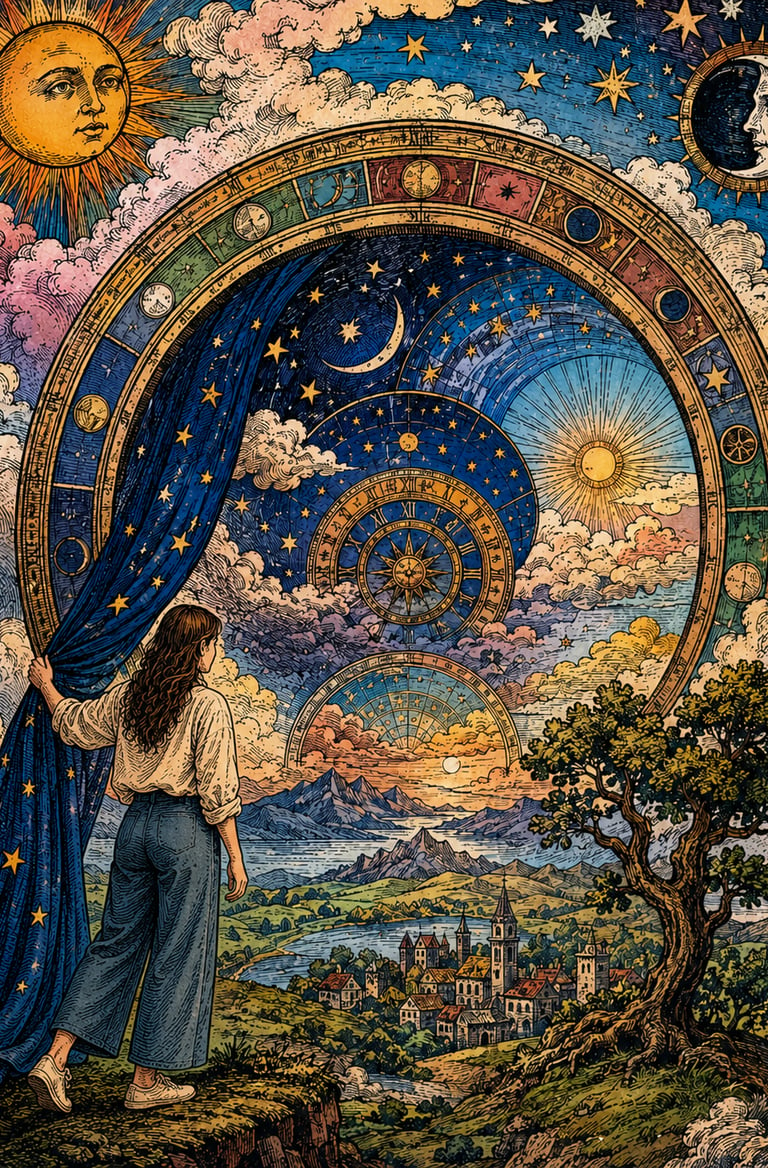
We live inside time so intimately that we rarely pause to ask what it is.
We measure it, spend it, waste it, save it, lose it, and chase it. We say, “I am this many years old,” or “Let’s meet on Wednesday,” and everyone understands what we mean. Yet the moment we turn toward time directly and ask, What is it? something in the intellect grows quiet.
A clock can tell us that an hour has passed, but it cannot tell us why one moment feels empty while another feels destined. It cannot explain why a season closes, why an opportunity arrives at the exact threshold of readiness, or why some experiences seem to belong not to minutes at all, but to eternity.
Despite humanity’s advances in science, technology, and measurement, time remains mysterious. It is among the most ordinary facts of daily life, and yet one of the least understood.
Ancient cultures knew this. They did not treat time merely as a neutral container through which events passed. They watched the heavens, rivers, seasons, moon cycles, harvests, rituals, and inner states. They sensed that time was not only counted. It was read. It was entered. It was aligned with.
Modern life often lives under one face of time: clock time. It is precise, efficient, administrative, and necessary. It tells trains when to leave, meetings when to begin, and cakes when to come out of the oven. But if clock time becomes the only time we recognise, life can begin to feel strangely thin.
We become punctual but not rhythmic, productive but not necessarily wise.
Perhaps the deeper question is not only, What is time?
Perhaps it is: What kind of relationship do we have with time?
Many ancient cultures built their calendars around natural and cosmic rhythms. The year was not merely a mathematical grid but a living pattern connected to rivers, moons, stars, solstices, rains, harvests, and sacred observances.
Ancient peoples often shaped timekeeping around what they could observe in nature. The flooding of a river, the return of a star, the cycle of the moon, the ripening of crops, the changing of seasons — these were not decorative additions to time. They were time.
Modern calendars, by contrast, are often more abstract. They are useful, regular, and practical, but they can feel detached from the living movements of earth and sky. January 1 arrives because the calendar says so, not because the cosmos visibly opens a new door.
This is not to romanticise the past or reject the present. The clock is useful. The calendar is useful. Nobody wants a dentist appointment scheduled by “the third shimmer after the moon feels emotionally complete.” That way lies chaos — and possibly root canal.
But ancient timekeeping reminds us that time was once felt as relationship.
Time linked the human being to the sky, the body to the season, the mind to the cosmos. Days had quality, not just quantity. The question was not only “What date is it?” but “What is this moment asking of us?”
This difference matters.
A society that sees time only as a resource may organise itself around extraction: more output, more speed, more consumption, more deadlines. A society that sees time as rhythm may organise itself around alignment: right action, right season, right preparation, right pause.
Clock Time and Cosmic Time
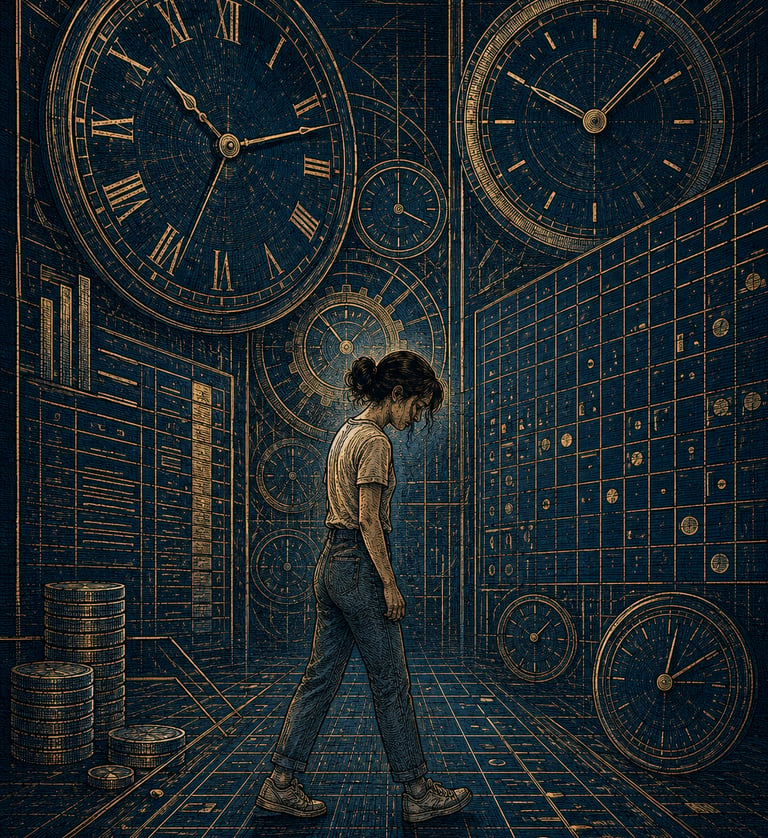

The modern age has almost entirely surrendered to chronic time: time as conventional measurement, time as administration, time as utility. It is time stripped of story. Time emptied of sacredness. Time reduced to a neutral background against which human beings are expected to produce, consume, compete, and keep up.
In this view, time becomes something to be “spent,” “saved,” or “wasted.” It becomes a private economic resource and a public political instrument. We are trained to divide it, manage it, monetise it, and fear its loss.
This is the world of “time is money.”
But the phrase reveals more than it intends. When time becomes money, life itself becomes an economy. The hour is no longer a living field of experience; it becomes a unit of extraction. The day is no longer a rhythm; it becomes a container for output. Even rest must justify itself by improving future productivity, poor thing — rest made to wear a business suit.
Chronic time belongs closely to a materialistic worldview. It assumes that reality is primarily made of measurable things, and that what cannot be measured is secondary, subjective, or less real. Within this worldview, the clock appears objective, while the inner experience of time — awe, readiness, meaning, synchronicity, grief, devotion, creative absorption — is treated as private decoration.
Yet this is already a philosophical position, not a final truth.
The Problem with Chronic Time
Modern science has given humanity extraordinary insight and power. But when science hardens into materialism, it can begin to assume that it already understands the nature of reality, leaving only the smaller details to be filled in. From that position, other ways of knowing are treated as “views,” while the materialist view quietly presents itself as truth itself.
This is subtle, but important.
The issue is not science. The issue is the narrowing of reality to only what the measuring instruments can confirm. A clock can measure duration, but it cannot measure significance. It can tell us that ten minutes have passed, but it cannot tell us whether those ten minutes healed a relationship, opened a destiny, or returned someone to themselves.
Chronic time is indifferent to what happens inside it. It ticks on whether we are awake or asleep, grieving or rejoicing, creating or collapsing. It does not care whether a moment is sacred or meaningless. It is passive background, not living participant.
When ruled by Chronos alone, time becomes the time of the ego: the part of us that must negotiate the demands of the external world, manage consequences, delay gratification, and survive within reality’s visible structures. This ego-function is necessary. It helps us participate in the world. It pays bills, catches buses, meets deadlines, and remembers that cake left in the oven too long becomes charcoal with ambition.
But the ego also lives under pressure. It knows limitation. It knows ageing. It knows that things end. When Chronos becomes the only recognised form of time, life becomes governed by scarcity and death-anxiety. There is never enough time. We are always late. Always behind. Always trying to catch a future that keeps moving its chair.
This is why a purely chronological life can become exhausting. It gives us structure, but not meaning. Sequence, but not story. Duration, but not depth.
Something in the human being knows there is more.
Every so often, another kind of time breaks through.
A moment arrives that does not feel like a point on a schedule, but like a doorway. A conversation, encounter, dream, book, illness, loss, landscape, or sudden realisation interrupts ordinary life and reveals something deeper.
These moments often feel strangely familiar. The wisdom that arrives through them does not feel like information being added from outside. It feels like recognition. It bypasses the everyday ego and resonates with something already present deep within us: the true self, the spiritual self, the part of us that remembers what the surface mind has forgotten.
This is why certain insights feel less like learning and more like being reminded. Something eternal touches the ordinary. Something timeless enters time. For a moment, heaven and earth appear to coincide.
This is the realm of synchronicity, revelation, and meaningful timing. It is what happens when time becomes more than measurement — when the outer event and the inner readiness meet. The world does not merely happen around us; it speaks.
And if we are listening, something in us answers.
When Timelessness Breaks Through
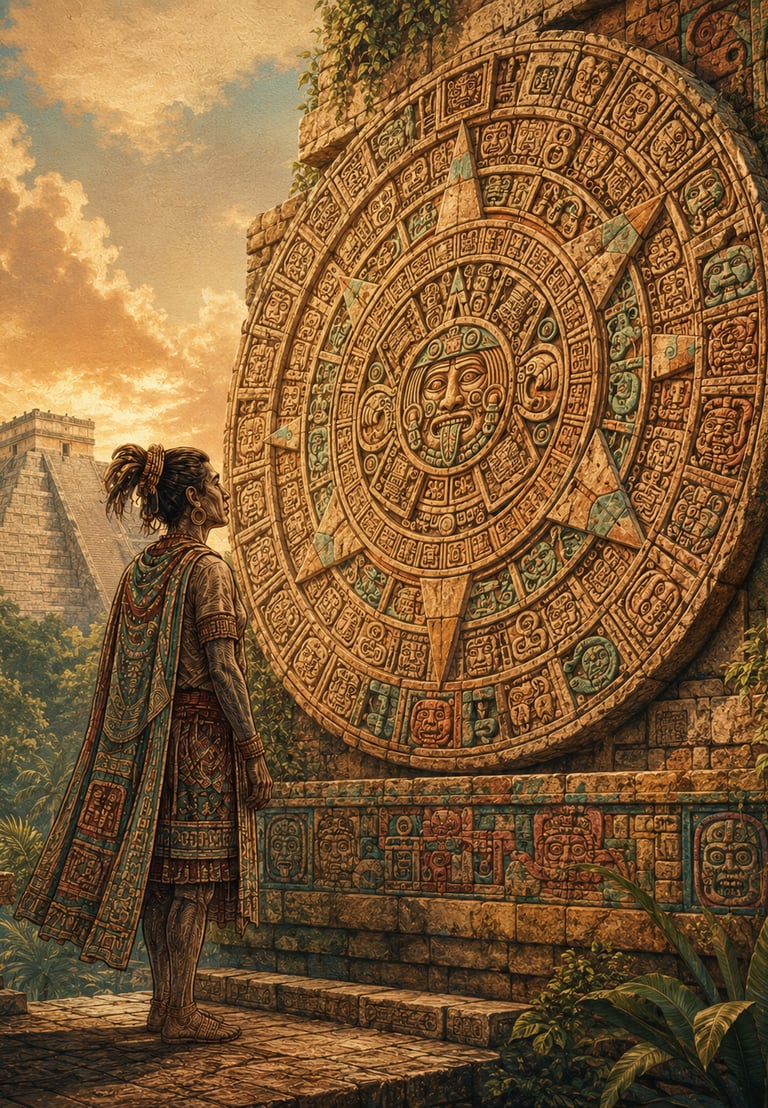

The Maya also understood time through interlocking cycles rather than a single straight line. Their calendar system included several counts, including the Tzolk’in, a 260-day sacred cycle; the Haab’, a 365-day solar cycle; and the Calendar Round, formed by the weaving together of these two cycles.
A given combination of Tzolk’in and Haab’ days repeats only after 52 Haab’ years, creating a larger rhythmic return.
This is time as pattern.
Time as interrelationship.
Time as sacred mathematics.
The Mayan calendar does not present a day as an empty square waiting to be filled with tasks.A day carries position within a larger weave. It belongs to a cycle, and that cycle belongs to another cycle. The human being is not standing outside time, controlling it from a distance. The human being is inside a living architecture of recurrence and meaning.
This is where the Mayan view becomes a beautiful first doorway into ancient time-consciousness. It gives us time as sacred pattern — a woven field in which number, cosmos, ritual, and human life meet.
Time, here, is closer to music than machinery.
A song has measure, but it is not only measure. It has rhythm, return, variation, silence, and crescendo. You cannot understand music only by counting beats.
You must listen.
Perhaps time is like that too.
The Mayans: Time as Sacred Pattern
The Ancient Greeks offered another luminous way into the mystery. They did not have only one idea of time. They distinguished between different qualities or modes of time, often expressed through Chronos, Kairos, and Aion.
Each gives us a different doorway into time.
Chronos
Chronos is chronological time. It is measured time. It is the time of clocks, calendars, sequences, deadlines, appointments, and duration.
Chronos is necessary. Without it, we could not coordinate practical life. Chronos helps us cook, travel, build, plan, and meet one another in the shared world.
But when Chronos dominates, time becomes something to spend, waste, save, or monetise. It becomes “time is money.” Life becomes a ledger. The soul starts living inside a spreadsheet with shoes on.
Chronos can support order, but if isolated from deeper forms of time, it can also produce anxiety. It is the time that reminds us of ageing, pressure, scarcity, and the sense that we are always running late for a life we have not yet fully entered.
Kairos
Kairos, by contrast, is meaningful time.
It is the ripe moment.
The opening.
The rightness of timing.
Kairos is not simply “what time is it?” but “what is this moment for?
Kairos is what we feel when an opportunity arrives at the exact moment
we are ready to receive it. It is the strange intelligence of synchronicity.
The teacher appears when the student is ready. The book falls open to
the line you needed. A conversation changes the direction of your life.
A door opens, and though the clock says it is an ordinary Tuesday,
some deeper part of you knows a threshold has appeared.
Kairos is more rhythmical, circular, and seasonal than linear. It is connected with meaningful coincidence, synchronicity, spiritual timing, and the perfect moment when things are ripe and ready.
With Kairos, time may seem to slow down, speed up, or briefly disappear. Athletes sometimes experience it when they enter “the zone.” Artists know it when hours vanish inside creation. Lovers, mystics, healers, and seekers may recognise it as the feeling that something larger has entered the ordinary.
Aion
Then there is Aion: sacred or eternal time.
Aion is not a better schedule. It is not time management with incense. It is the dimension of timelessness that seems to underlie and suffuse ordinary time.
Aion is expansive time. It is sometimes described as an infinite sphere whose centre is everywhere and whose circumference is nowhere. Unlike Chronos, it is not bound to sequence. Unlike Kairos, it is not only the ripe moment arriving within time. Aion is the vastness in which time and timelessness meet.
The time of Aion grants us participation in eternity. It is always present, even when we imagine ourselves trapped somewhere along Chronos’ timeline, or when we are swept into the meaningful urgency of Kairos. Aion is the quiet, spacious reality beneath both. It does not rush, because it does not lack. It does not measure, because it is not trying to arrive.
Chronos and Kairos happen alongside one another, a little like heaven and earth: one reality can be seen, measured, and scheduled, while the other is felt, recognised, and entered through meaning. Chronos may tell us what hour it is, but Kairos tells us what the hour is for.
Aion expands the field further.
If Chronos is the time of the literal-minded ego, and Kairos is the time of the creatively awakened soul, Aion is the time of the Self. It is the dimension in which the boundary between what happens to us and what we make happen begins to dissolve. Life is no longer experienced only as a series of external events pressing upon us. Nor is it merely a chain of opportunities we must seize. It becomes participation — a living relationship between the visible and invisible, the temporal and eternal, the human and the vast.
Ancient Greece: Three Faces of Time


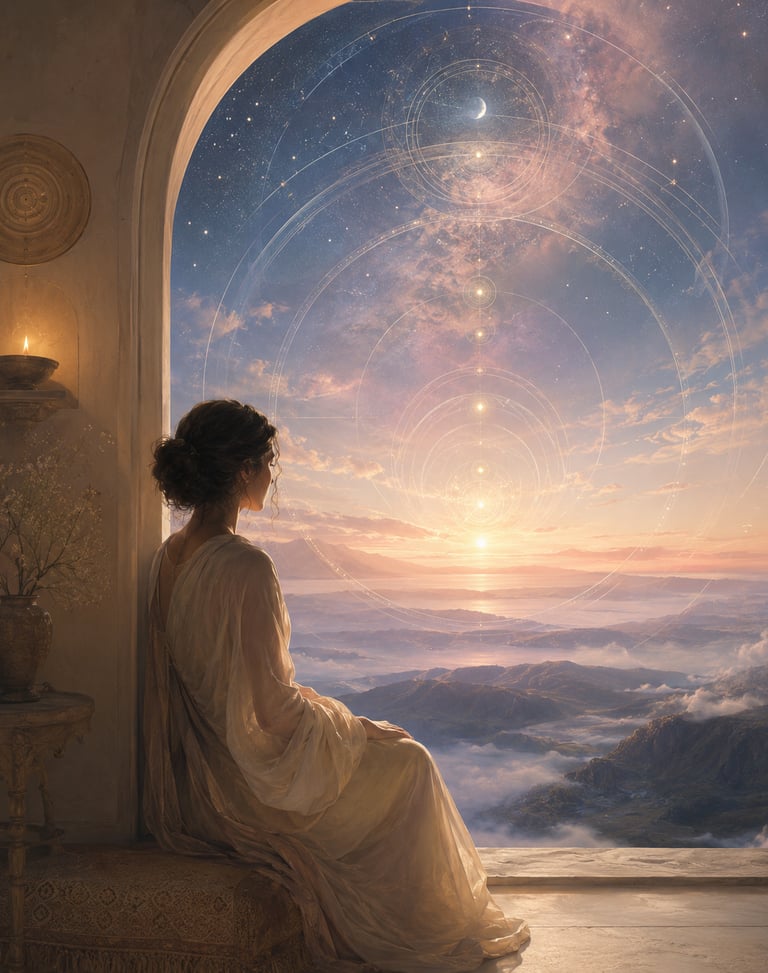

Chronos measures.
Kairos invites.
Aion expands.
All three matter.
If Chronos is the time of the practical self, Kairos is the time of the awakened soul, and Aion is the time of the deeper Self, then a whole life requires a relationship with all three.
We need Chronos to function.
We need Kairos to create and respond.
We need Aion to remember that life is larger than its visible edges.
And from here, the lens widens again.
If Aion gives us a glimpse of eternal, expansive time, the Indian understanding of the Yugas offers a macrocosmic view — a vantage point from which we zoom out beyond the individual life, beyond the single generation, and begin to contemplate the movement of consciousness across vast cycles of civilisation.
Here, consciousness does not simply mean thought, intelligence, or opinion. It refers to the depth and quality of awareness through which human beings perceive reality. It is the inner instrument by which we know ourselves, relate to others, interpret the world, recognise truth, and respond to life.
From Inner Time to Vast Time
This matters because evolution is often understood only externally: better tools, larger cities, faster machines, more advanced systems. But from a spiritual perspective, true evolution is not merely what happens in the outer world. It is what happens in consciousness.
A civilisation may become technologically powerful while remaining inwardly fragmented. It may master matter while forgetting meaning. It may progress outwardly while becoming less subtle in perception, less attuned to truth, and less integrated within.
The Yugas give language to this larger movement. They suggest that time is not only the passing of years, but the changing atmosphere of consciousness itself. Each age carries certain conditions: what humanity can easily perceive, what it tends to forget, what it values, what it fears, and what kind of knowledge becomes available or hidden.
The Yugas are not Aion itself. They are not eternity in its pure, unbounded form. But they provide a language for how a portion of that vastness may be patterned, expressed, and experienced through the rise and fall, forgetting and remembering, densification and refinement of human consciousness over time.
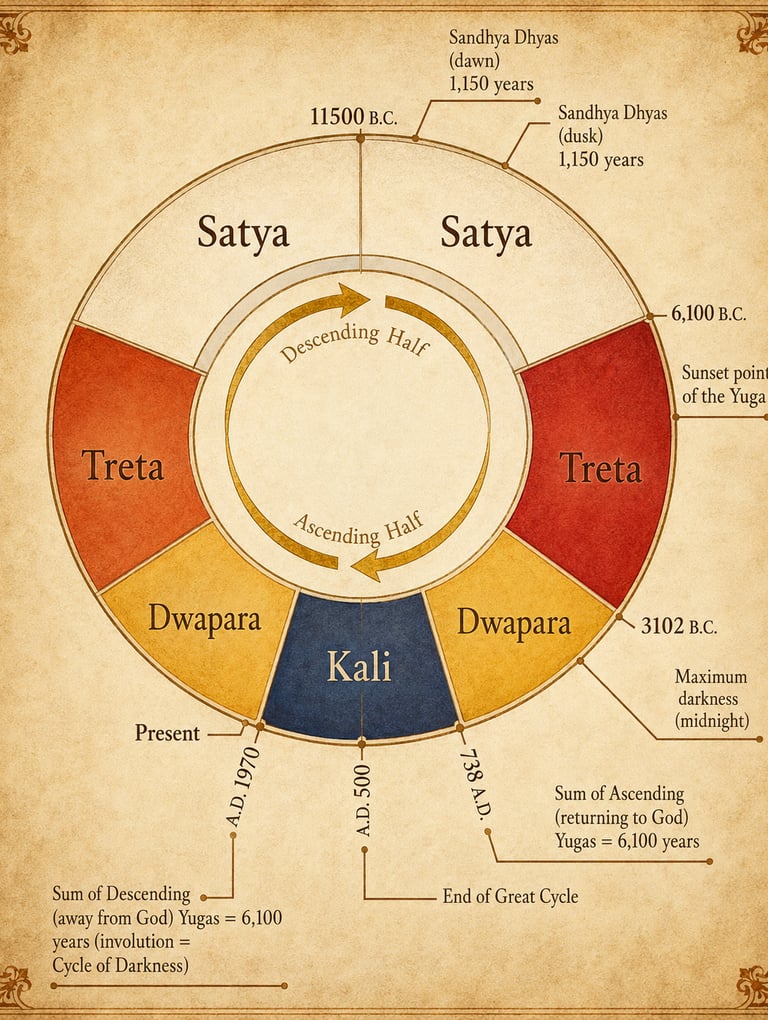

In the Indian tradition, time is often understood cyclically rather than only linearly. One of the profound frameworks for this is the concept of the Yugas — vast ages through which human consciousness and civilisation move.
The Yugas present time as a great cycle of descent and ascent, where humanity passes through different stages of awareness, refinement, and relationship to truth. These ages are not merely historical periods. They are atmospheres of consciousness.
In one age, humanity may become more materially focused, more bound to survival, conflict, and external forms of power. In another, subtler knowledge begins to awaken. In another, human beings may become more attuned to the deeper forces of life, nature, spirit, and mind.
Whether one approaches the Yugas literally, symbolically, spiritually, or philosophically, they offer a striking idea: time is not empty. It carries conditions. It shapes what is easy to perceive and what is difficult to perceive. It influences the atmosphere of an age.
In this view, history is not merely a straight march from primitive to advanced. It is a vast breathing.
Civilisation rises and falls.
Forgets and remembers.
Densifies and refines.
Knowledge may be lost and rediscovered. Consciousness may become more material, then slowly more subtle again
Ancient India: Time as Consciousness Cycle
This is a very different way of seeing human development. It invites humility. We may have more devices than our ancestors, but that does not automatically mean we have more wisdom. A culture can become technically brilliant while spiritually distracted. It can master external tools and forget the inner instrument.
The Yuga lens also gives us a language for transition. It suggests that the mood of an age is not random. Human beings live inside cycles larger than one lifetime, one government, one economy, or one trend.
We are not only managing our personal schedules.
We are participating in civilisational weather
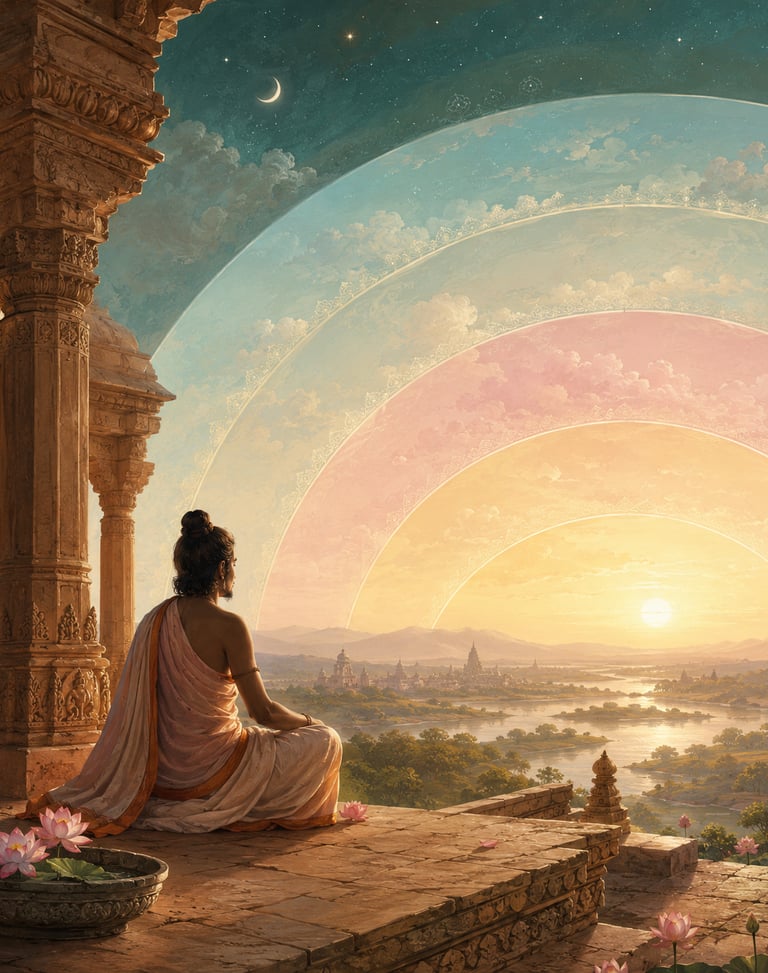

Together, these perspectives begin to reveal a deeper possibility: time may not be merely a flat line along which events happen. It may be patterned. It may carry qualities. It may move through cycles that can be observed outwardly in the cosmos and inwardly in consciousness.
The Maya reveal time through sacred calendars, interlocking cycles, and celestial observation. Their understanding of time was inseparable from rhythm: the movements of the Sun, Moon, Venus, ritual days, solar years, and larger returns.
The Greeks reveal time through lived experience. Chronos measures, Kairos invites, and Aion expands. Through them, time becomes not only something outside us, but something we experience differently depending on our state of awareness, readiness, and relationship to meaning.
The Indian Yugas reveal time through a macrocosmic view of consciousness. They suggest that civilisation itself moves through great cycles of forgetting and remembering, density and refinement, material focus and spiritual perception.
In this sense, astronomy and astrology become important background languages of ancient time-consciousness. Astronomy observes the measurable movements of celestial bodies. Astrology, in its older symbolic sense, asks how those movements may correspond with earthly life, human nature, collective moods, and cycles of change.
Reading Time as Pattern
This does not mean the Mayan calendars and the Indian Yugas are the same system. They are not. They arise from different civilisational worlds, with different symbols, calculations, and cosmologies. But they can be read as companions because both point toward a shared intuition: time is not random. It has rhythm. It has pattern. It can be observed through the sky and reflected through life.
One system begins with the patterned day.
Another expands into patterned ages.
Both invite us to look beyond flat clock-time and ask whether time may carry conditions, thresholds, and qualities of consciousness.
If these ancient perspectives teach us anything, it is that time is not only something we move through. It is something we participate in.
We respond to it.
We attune to it.
We misalign with it.
We learn from it.
The great cycles of the sky and civilisation are mirrored in smaller cycles of breath, body, attention, sleep, grief, creativity, and renewal. We are not separate from rhythm. We are made of it.
To live in rhythm again may begin simply.
Notice the season you are in.
Notice when effort is clean and when it has become force.
Notice what keeps returning.
Notice what has ended but is still being carried.
Notice what arrives quietly, again and again, until you finally understand it is a door.
We do not need to abandon clocks or calendars. We need them. But we also need to recover sensitivity to timing, readiness, rest, intuition, and inner season.
The question is not only, “How do I manage my time?”
It is also, “How do I listen to it?”
Living in Rhythm Again
Time is not only something we measure. It is something we participate in.
The ancient Indian Yugas remind us that time moves through great cycles of consciousness. The Mayan calendar reminds us that time may be woven through sacred patterns and interlocking rhythms. The Greeks remind us that time has different faces: Chronos, the measurable; Kairos, the meaningful; and Aion, the eternal.
Together, these perspectives invite us into a wider relationship with time.
We can still arrive on time for appointments. We can still meet deadlines, pay bills, and use calendars. But beneath all that, we can begin to listen for another order — the rhythm beneath the schedule, the season beneath the task, the invitation beneath the event.
Time as Art
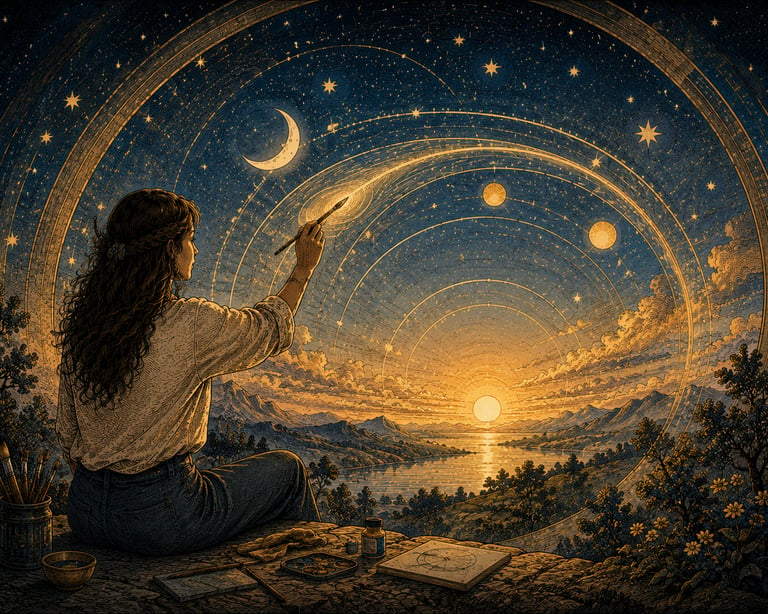

Maybe time is not a prison we are trapped inside
Maybe it is a language we are slowly learning to read.
And maybe the art of living is not to conquer time, but to become intimate with it — to know when to act, when to wait, when to release, when to begin, and when to recognise that a moment has opened like a curtain, revealing a larger sky.
Further Perspective
For readers who would like a wider scientific and cultural journey through humanity’s changing understanding of time, Quanta Magazine’s visual essay “What Is Time? A History of Physics, Biology, Clocks and Culture” offers a thoughtful companion perspective across ancient calendars, physics, biology, clocks, and culture.
For readers who would like to explore this theme further, the following sources offer useful companion perspectives:
Swami Sri Yukteswar — The Holy Science
A key source for the Yuga framework, especially in relation to cycles of consciousness.Smithsonian National Museum of the American Indian — Living Maya Time
A helpful introduction to Mayan calendars, sacred cycles, and the relationship between time, sky observation, and cultural life.Matthew T. Segall — writings and talks on Chronos, Kairos, Aion, and archetypal cosmology
Useful for exploring the Greek dimensions of time as measured, meaningful, and eternal.Larry Culliford — Time and Timelessness
A reflective companion on moments where ordinary time and timelessness appear to intersect.Quanta Magazine — What Is Time? A History of Physics, Biology, Clocks and Culture
A rich visual essay tracing humanity’s changing understanding of time across physics, biology, clocks, calendars, and culture.
Further Reading & References
© 2025. All rights reserved