
What is Sattva?
The Three Gunas and The Path to Clarity
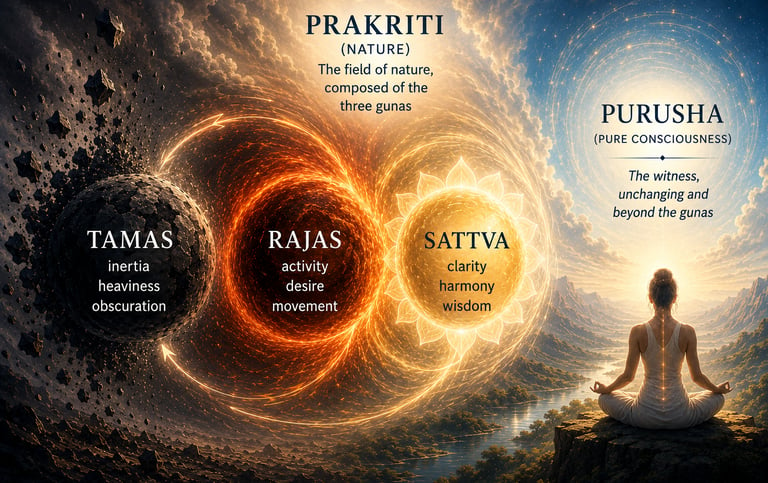
In ancient Vedic knowledge, the whole of creation is understood to be shaped by three gunas — fundamental qualities or modes of expression.
These three gunas are sattva, rajas, and tamas.
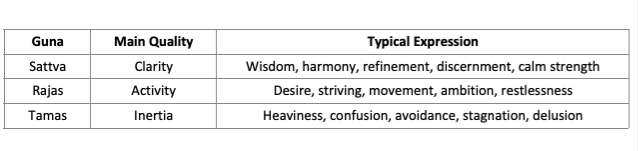
Sattva is associated with clarity, truth, harmony, refinement, wisdom, and spirituality.
Rajas is associated with activity, movement, desire, stimulation, and restlessness.
Tamas is associated with inertia, heaviness, obscuration, ignorance, and stagnation.
These qualities do not exist only as ideas. They are inbuilt into the architecture of the cosmos. They are the baseline qualities — the building blocks — through which manifestation operates.
The Larger Framework: Prakriti and Purusha
Yoga philosophy describes existence through two broad principles: Prakriti and Purusha.
Prakriti is Nature, the changing field of existence. This includes everything that changes: the body, mind, senses, thoughts, emotions, physiology, food, environments, time, action, matter, and energy.
Purusha is the unchanging Self or soul — the witnessing consciousness beyond change.
The three gunas belong to Prakriti. This means they operate throughout the changing field of life.
Why the Gunas Matter
The gunas are not simply descriptions of personality. Because they are inbuilt into the architecture of the cosmos, they directly influence the constituents through which human experience takes place.
They affect perception, thoughts, emotions, moods, attention, energy, physiology, habits, behaviour, the senses, and environments. In other words, they influence the very materials through which inner and external reality are experienced. This is why ancient traditions placed such importance on understanding and refining them.
The Gunas in Human Experience
Although the gunas operate universally, they express uniquely within each individual.
A person is rarely purely sattvic, rajasic, or tamasic. Most people contain all three qualities in changing proportions. At different times, one may become more dominant.
Over time, this shapes tendencies, choices, habits, actions, and direction in life.
The Fruits of the Gunas
Each guna tends to produce different experiences and outcomes.
Sattvic action tends toward harmony, purity, wisdom, and peace.
Rajasic action tends toward effort, striving, stimulation, dissatisfaction, and fluctuation.
Tamasic action tends toward confusion, neglect, inertia, and suffering.
These are not moral categories. They are observations about qualities and their effects.
Gunas and Daily Life
The gunas may be observed throughout daily life. Traditional teachings often describe early morning as more sattvic, midday as more rajasic, and night as more tamasic.
They may also express through food, speech, music, spaces, relationships, study, movement, work, habits, media, and attention. The same environment, activity, or object may affect consciousness differently depending on its qualities.
Gunas and the Five Elements
The gunas also work together with the five elements: earth, water, fire, air, and ether.
The elements form the structure of manifestation. The gunas influence the quality and behaviour of that structure.
For example, earth may express as:
Tamasic — heavy, stagnant
Rajasic — disturbed, unstable
Sattvic — grounded, balanced, nourishing
This helps explain why places, foods, activities, and environments can feel different despite appe
The Three Gunas at a Glance
All three have a role.
Tamas gives structure and stability. Rajas generates movement and activity. Sattva refines and illuminates.
The Three Gunas
Sattva is the most refined and illuminating of the three gunas.
It is associated with clarity, truth, wisdom, harmony, discernment, balance, purity, self-control, refinement, and spiritual aspiration. Its essential function is to reveal. As sattva increases, perception becomes clearer and life begins to feel more ordered and intelligible.
How Sattva Is Recognised
Traditional teachings describe sattva as becoming evident when the “light of wisdom” begins expressing through the gates of perception.
In practice, this may appear as clearer thinking, steadier emotions, calm energy, disciplined senses, truthful speech, balanced action, increased self-awareness, improved discernment, inner steadiness, and movement toward truth.
Sattva does not remove action. It refines action.
Sattva and Coherence
Sattva and coherence are related, but they are not the same thing.
The gunas influence the constituents through which we function — body, psyche, emotions, thoughts, senses, physiology, and behaviour.
As the gunas come into more rightful relationship — particularly through cultivating the more refined and illuminating quality of sattva — greater inner order begins to emerge.
This inner order influences the quality of the subtle field that organically arises from the soul. Coherence may therefore be understood as the quality of that field.
A more coherent field may shape how a person perceives, responds to, and participates in life. Over time, this can influence the kinds of environments, relationships, habits, opportunities, and experiences that are sustained or naturally become more available.
These conditions may then make further sattvic refinement easier to cultivate. In this way, refinement and coherence may gradually reinforce one another.
Coherence is not imposed. It arises.
How the Gunas Affect Inner State and Coherence
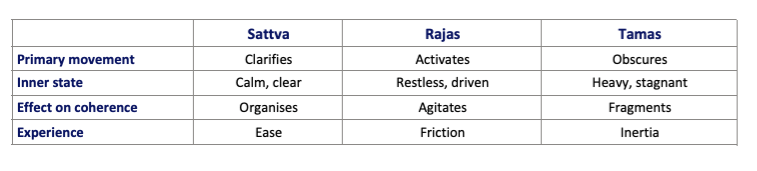
This helps show why sattva supports coherence. When sattva predominates, the inner field becomes clearer and more ordered. When rajas predominates, the field may become overstimulated or agitated. When tamas predominates, the field may become heavy, fragmented, or difficult to move.
Beyond Sattva
Although sattva is considered the most refined of the three gunas, it is not the final destination.
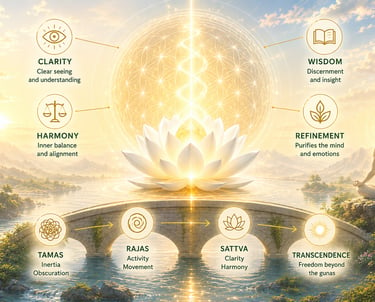
Sattva belongs to Prakriti and therefore remains within the realm of Nature and change. Although sattva is the most refined and illuminating of the three gunas, the highest aim is ultimately to move beyond identification with all three gunas and realise the unchanging Self (Purusha) that exists beyond them. The practical movement is often described as:
Tamasic qualities → Rajasic qualities → Sattvic qualities → transcendence
OR
Inertia → Activity → Clarity → Liberation
Sattva therefore acts as both a quality and a bridge. It refines consciousness and prepares the ground for deeper realisation.
Sattva
Further Perspective
If this reflection resonated, you may enjoy the following readings and content:
From Reflections:
What Is Kurukshetra?
What Is Discrimination/Buddhi
From Reading Room - Living Traditions
Bhagavad Gita Companion
Practice: ?
© 2025. All rights reserved